

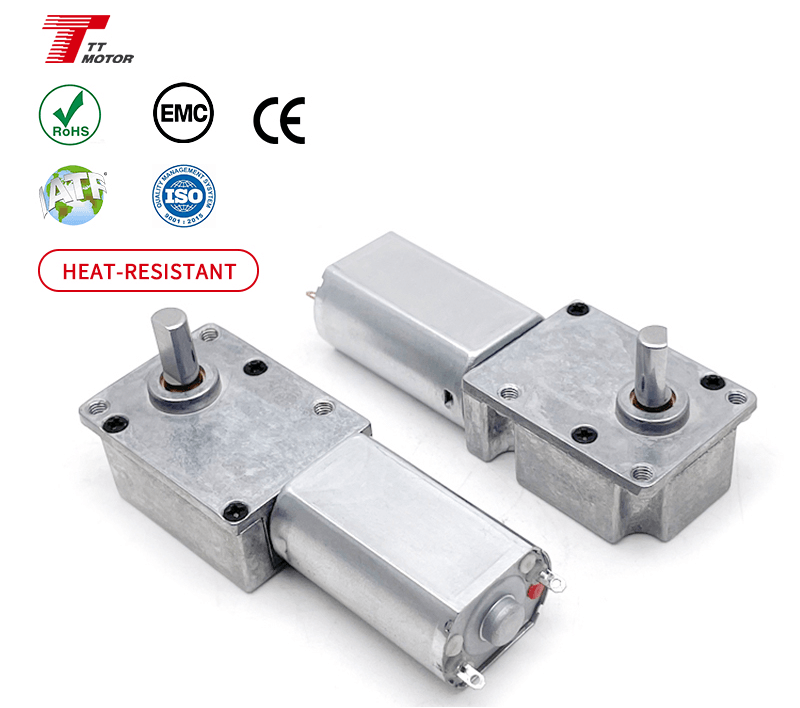
When a project requires a compact actuator that can hold position without an external brake, the worm gear motor is often the best choice. TT MOTOR’s TWG2534-180SH series combines a 180‑size permanent magnet DC motor with a 25×34mm worm gearbox, offering reduction ratios of 65:1 and 131:1. The worm drive provides two key benefits: high reduction in a single stage and back‑driving self‑locking – meaning the output shaft cannot be turned by external force when the motor is off. This makes the TWG2534‑180SH ideal for applications like valve actuation, lift tables, camera gimbals, and smart lock mechanisms.
This selection guide helps you choose the right voltage and reduction ratio based on your speed, torque, and power supply.
Step 1: Match Reduction Ratio to Your Speed and Torque Needs
The 65:1 ratio is suitable for applications that require moderate speed and lower torque. For example, a small camera gimbal that needs to pan at around 70–80 rpm under light load (0.2–0.3 kg·cm) works well with the 12V version driving a 65:1 gearbox. The output speed under load is 66 rpm, which provides smooth, controlled motion without being too slow.
The 131:1 ratio is designed for high‑torque, low‑speed scenarios. Typical uses include electric ball valves, where the motor must overcome initial static friction and then hold the valve position against fluid pressure. With the 6V motor and 131:1 gearbox, the rated output torque is 0.9 kg·cm at 45 rpm. This is more than sufficient for most ½‑inch to 1‑inch brass valves. Even the 12V version at 131:1 gives 0.45 kg·cm at 32 rpm, which works well for smaller plastic valves or dampers.
Step 2: Choose the Right Voltage for Your System
If your product runs on battery power (four AA cells, a single 2‑cell Li‑ion pack, or a USB power bank), choose the 6V TFF‑180SH‑18140 motor. It offers higher torque per amp and lower stall current than the 12V version. For example, the 6V motor has a stall torque of 1271 g·cm (≈1.27 kg·cm) at a stall current of 1.80A, while the 12V motor stalls at 710 g·cm with only 0.42A. The 6V motor is better suited for applications where high starting torque is essential – such as breaking loose a sticky valve.
If your product is part of an automotive or industrial system with a stable 12V supply, the 12V TFF‑180SH‑10400 motor is the natural choice. Its lower stall current (just 0.42A) reduces stress on the power supply and driver circuit. The 12V version also runs slightly faster at both ratios, which may be desirable for applications like hospital bed adjustment or electric wheelchair leg lifts, where moderate speed is preferred over maximum torque.
Step 3: Leverage the Self‑Locking Feature
One of the most valuable characteristics of a worm gear reducer with ratios above 30:1 is self‑locking. Both 65:1 and 131:1 ratios fully satisfy this condition. When the motor stops, the load on the output shaft cannot back‑drive the motor. This eliminates the need for an electromagnetic brake or a complex gear train with a holding mechanism.
For example, in a height‑adjustable TV lift stand, the motor raises the platform and then stops. Without self‑locking, the weight of the TV would slowly lower the platform over time. With the TWG2534‑180SH, the platform stays exactly where it stops. Similarly, in a solar tracker actuator, the motor holds the panel angle against wind loads without consuming power. This feature also simplifies safety certifications for medical and lifting equipment.
Typical Applications at a Glance
Electric ball valves and gate valves are perhaps the most common application for this motor series. A 6V model with 131:1 ratio delivers 0.9 kg·cm at 45 rpm – plenty to turn a ½-inch brass ball valve. The self‑locking nature keeps the valve fully open or fully closed without power, which is critical for battery‑operated irrigation systems.
Small lift and linear actuator systems benefit from the motor’s high torque per size. For a hospital bed backrest adjuster, the 12V version at 65:1 provides 0.22 kg·cm output torque at 66 rpm. With a lead screw mechanism, this translates into 5–10 kg of linear force, enough for light duty adjustments.
Security cameras and pan‑tilt units require smooth motion and precise stopping. The 12V motor with 131:1 ratio runs at 32 rpm under load, turning a camera platform at about 6–8 seconds per full rotation. The worm gear’s natural resistance also prevents the camera from drifting due to wind or cable tension.
Vending machine dispensing mechanisms often need to push a product forward and then hold against the next item. The 6V model at 65:1 (90 rpm under load) offers a good balance of speed and torque for pushing lightweight snacks or medicine blister packs.
TT MOTOR provides sample testing and custom modifications including shaft length, connector type, and special lubricants for extreme temperatures. Contact our engineering team to discuss your specific application.
Post time: May-13-2026