

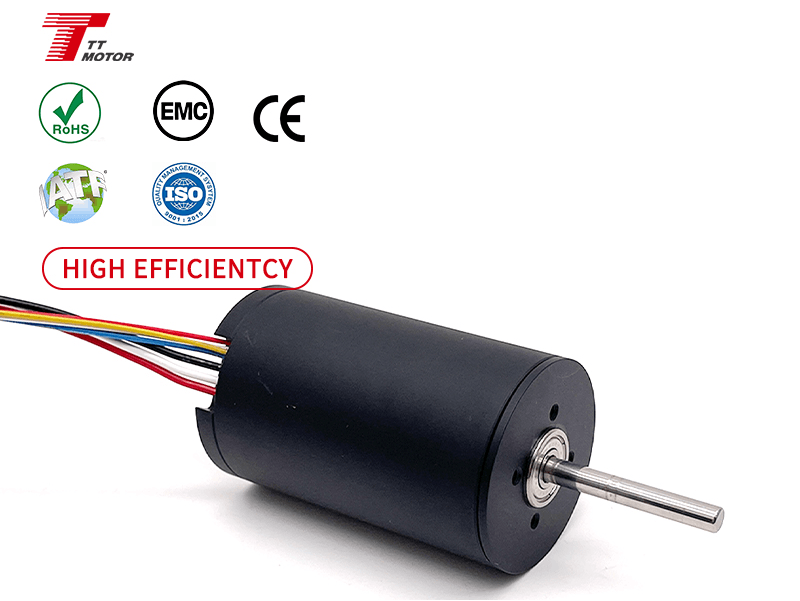
At TT MOTOR, the TBC4370 series represents a high-power-density brushless DC motor platform designed for applications demanding continuous torque, wide speed range, and long service life. With two standard voltage variants (24V and 48V), this 43mm‑frame motor delivers up to 2000 g·cm rated torque and exceeds 90W output power. But what do these numbers really mean for your design?
1. Rated Voltage & Windings – 24V vs. 48V
The datasheet shows two models: TBC4370‑2450 (24V) and TBC4370‑4850 (48V). The higher voltage version is not simply a drop‑in replacement – it uses different winding turns to achieve similar no‑load speeds (~5000 rpm). Why offer both?
24V is common in automotive, industrial controls, and mobile equipment (e.g., AGVs, electric actuators).
48V is gaining traction in light EVs, power tools, and server cooling – it reduces current for the same power, minimizing I²R losses and allowing thinner wiring.
TT MOTOR’s design choice: Both versions maintain nearly identical mechanical envelopes, so you can switch voltages without changing mechanical interfaces – only the controller and wiring need adjustment.
2. No‑Load vs. Rated Speed – Understanding the Drop
From the 24V model:
No‑load speed ≈ 4950 rpm
Rated speed (at rated torque) ≈ 4500 rpm
The speed drop is only about 9% from no‑load to rated load. This indicates a stiff speed‑torque characteristic – a hallmark of good BLDC design with low internal resistance. A larger drop would suggest high armature resistance or weak magnetic flux. For applications like conveyor drives or fan systems, this stiffness means stable speed even when load fluctuates.
3. Rated Torque & Power – Where the Real Work Happens
The TBC4370‑2450 delivers 2000 g·cm (≈0.196 Nm) at rated load.
Exactly matching the datasheet’s 92.3W rating. This is the continuous operating point – the motor can run indefinitely at this torque without exceeding thermal limits, provided proper heat sinking.
Why 2000 g·cm matters: This torque can lift a 2 kg weight with a 1 cm radius pulley, or drive a pump impeller requiring moderate pressure. It’s suitable for medical infusion pumps, small robot arm joints, or electric screwdrivers.
4. Current Consumption – Efficiency Insight
At rated load, the 24V model draws 6000 mA (6.0A). Input electrical power = 24V × 6.0A = 144W. Output mechanical power = 92.3W → efficiency ≈ 64%.
For a brushless motor of this size (43mm diameter, 70mm length), 64% at full load is reasonable, especially when including controller losses. At lower loads, efficiency often rises above 75%. The 48V version, with 2000 g·cm torque and 2600 mA current (48V × 2.6A = 124.8W input), achieves 74% efficiency – better because lower copper losses dominate. Thus, if your system can support 48V, you‘ll get cooler operation and longer battery runtimes.
5. Stall Torque & Current – What Happens at Start‑Up
Stall torque (locked‑rotor) for the 24V model is 22,000 g·cm (≈2.16 Nm), and stall current is 80A. That’s 11 times rated torque and over 13 times rated current.
Engineering implications:
The motor can break away stuck loads with huge momentary force.
The controller must be rated for at least 80A peak current (even for a few milliseconds).
Do not operate at stall for more than a second – otherwise the windings will overheat rapidly.
For applications like electric parking brakes or valve actuators that only stall briefly, this high torque margin is invaluable.
6. Mechanical Construction – What the Datasheet Doesn’t Show
Though not detailed in this excerpt, the TBC4370 series typically features:
Hall sensors for six‑step commutation (or sensorless optional).
Pre‑loaded ball bearings for radial loads up to 80N.
IP40 protection (open frame), with optional IP54 for dusty environments.
4‑pole rotor design – balancing low cogging with high torque density.
Weight is listed as 520g – reasonable for a 43×70mm BLDC motor, indicating solid steel lamination and copper fill.
Post time: May-01-2026