

Motor Layout and Mounting Configurations:
The humanoid dexterous hand consists of a thumb and four fingers. Each finger has three degrees of freedom: metacarpophalangeal, proximal interphalangeal, and distal interphalangeal. Some models incorporate a wrist rotation joint, and the motors are fully compatible with all drive points: individual motors are mounted on each finger joint to enable flexion and extension; motors mounted at the base of the fingers enable lateral swinging and spreading/closing motions; The hand base incorporates this motor to drive wrist rotation and fine pitch adjustments.
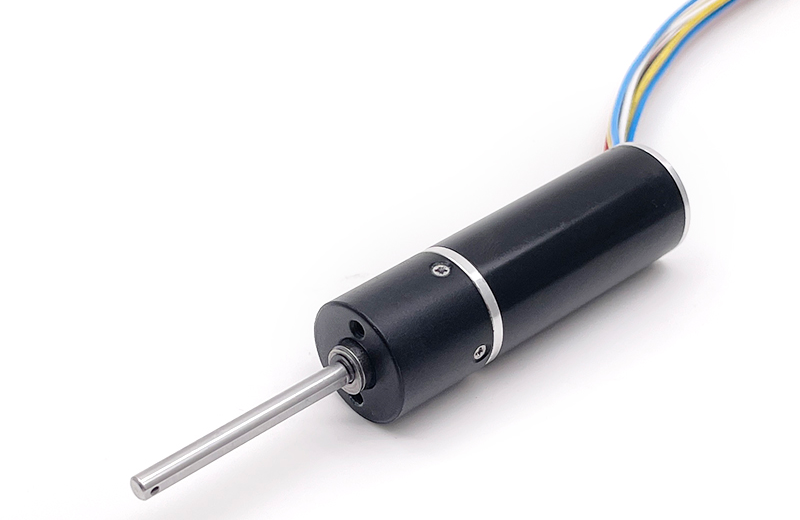
Compact and lightweight: With an outer diameter of just 16 mm, the motor fits within the narrow internal cavities of the fingers, allowing for dense arrangement of drive units and enabling a single robotic hand to achieve 10–15 degrees of freedom; the entire unit weighs only a few hundred grams, with no additional load, ensuring the robotic arm’s overall agility.
High assembly adaptability: The front end features standard M2 mounting holes, compatible with lightweight brackets and micro-linkages. This enables convenient assembly, simplifies structural design, and supports mass production and modular modifications.
Flexible and adjustable specifications: The overall length of the motor varies with the gear ratio. Users can select the appropriate gearbox size based on finger dimensions to accommodate different bionic hand structures.
Core Performance Advantages:
Torque-Smooth Operation: Utilizes a hollow-cup, ironless core structure to completely eliminate motor cogging. Low-speed operation is smooth and shock-free, enabling precise execution of delicate movements such as slight finger bending and gentle pinching. It stably grasps fragile, lightweight components like cotton swabs, chips, glass slides, and cables, highly replicating the movements of a human hand.
Fast Dynamic Response: With extremely low rotor inertia, start-stop response time is <10 ms. It enables rapid actions such as clenching, opening, tapping, and posture switching, with high synchronization in multi-finger coordination for lifelike biomimetic performance. It also supports high-frequency repetitive operations, meeting the demands of equipment demonstrations, performance testing, and continuous assembly line work.
Planetary Reduction: A multi-stage planetary reduction structure balances the dual requirements of gentle pinching and stable gripping. At low torque output, the gripping force is gentle, allowing for the safe handling of fruits, silicone parts, and precision electronic components without damage; with sufficient rated torque, it can securely hold small tools and metal parts, preventing slippage or dropping; peak torque reaches 500 mNm, capable of withstanding instantaneous forces and impacts, ensuring high structural durability.
Long Service Life: The brushless design ensures a service life exceeding 10,000 hours, making it suitable for 24/7 continuous operation in research equipment, rehabilitation prosthetics, and commercial robots, with low maintenance costs; the motor operates at 85%–90% efficiency with low current consumption, meeting the long battery life requirements of portable bionic hands and exoskeleton rehabilitation hands.
Closed-Loop Control: Equipped with a Hall sensor as standard and an optional encoder, it achieves closed-loop control when paired with a dedicated driver. In terms of position, it precisely controls finger bending angles, offering high repeatability and stable posture; in terms of force, it provides real-time feedback on gripping force, enabling flexible and intelligent grasping—a core guarantee for the bionic hand’s precision operations.
Low Noise: Operating noise is ≤35 dB, making it suitable for scenarios such as exhibition hall demonstrations, home service robots, and rehabilitation assistive devices, thereby enhancing the user experience.
Post time: Jul-08-2026